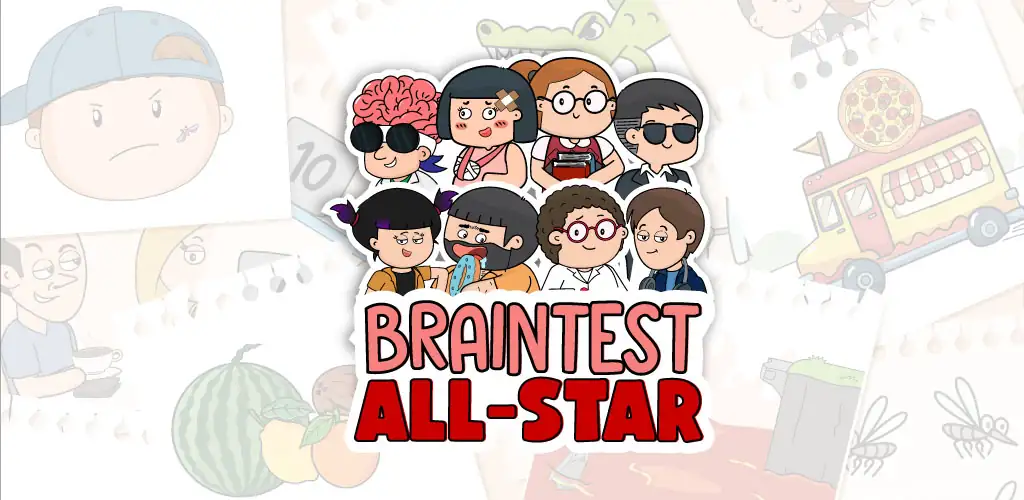
What is Brain Test All-Star: IQ Boost?
Brain Test All-Star: IQ Boost is a lateral thinking puzzle game that scores your performance across more than 1000 riddle levels and uses the results to track intelligence development. Tap, drag, or shake objects on screen to solve brain teasers that rely on wordplay, visual tricks, and unconventional logic.
The core structure presents a single puzzle per screen with minimal UI. You interact directly with illustrated objects to find solutions that often ignore the obvious approach. A lock might open by tilting your phone instead of finding a key. The IQ scoring system assigns points based on completion speed and hint usage, then graphs your progress across categories like spatial reasoning and pattern recognition. Daily challenges rotate in fresh puzzles with bulb rewards you spend on hints. A separate hard challenge mode targets players who completed earlier entries in the franchise, filtering for veteran-level difficulty. Familiar characters from previous installments appear across levels: Agent Smith, Monster Hunter Joe, Uncle Bubba, Doctor Worry, and Tom the Cat return with new scenarios.
Key Features:
- Over 1000 levels span wordplay riddles, visual gags, and physics interactions, with frequent updates adding more.
- The IQ scoring system tracks performance across puzzle types and displays development metrics over time.
- Daily challenges deliver one unique puzzle per day with bulb currency as a completion reward.
- Hard challenge levels offer a difficulty tier designed specifically for players familiar with the franchise's earlier games.
- Hint and skip systems let you spend earned bulbs to reveal clues or bypass puzzles entirely.
- The game runs offline with no connection or WiFi requirement, and the one-handed control scheme works for commutes or quick sessions.
How the puzzles work
Each level isolates a single riddle with a question prompt and an interactive scene. Solutions rarely follow literal instructions. A level asking you to wake someone up might require shaking the device rather than tapping an alarm clock. Another might hide the answer in the question text itself. The challenge comes from recognizing when the game is misdirecting you and testing solutions outside the expected framework. Controls adapt per puzzle: some use drag gestures, others respond to tilt, and a few require rapidly tapping specific elements. The hint system offers three tiers of guidance, starting with a vague nudge and escalating to a step-by-step walkthrough if you spend enough bulbs.
Games like Brain Test All-Star: IQ Boost
Brain Out leans harder into trick questions and absurdist humor, while Brain Test All-Star: IQ Boost balances lateral thinking with recognizable puzzle logic. Brain It On! centers on physics-based drawing challenges where you sketch shapes to solve spatial problems, a mechanic-driven approach compared to the riddle-and-interaction focus here. Players looking for pure troll logic should try Brain Out; those who want tactile problem-solving over drawing will prefer Brain Test All-Star: IQ Boost.
The game is built for casual puzzle fans who enjoy brain teasers without time pressure and want offline access for travel or downtime. Puzzle logic becomes repetitive across extended play sessions, with many levels reusing the same misdirection tricks in different visual wrappers. The hint system and skip option keep frustration low for all skill levels.



Share your experience with other users.